WELCOME!

Tuesday, April 27, 2021

 Henry the Eighth and the Bernie Bus

by KENNETH E. HALL APRIL 27, 2021

My memories of the Sixties are wide and varied; “they go from the sublime to the ridiculous” as my PawPaw would have said. One on the ridiculous side was of a novelty song that was released in June of 1965 and topped the charts at #2 on July 14 of that same year. 

♫ Herman's Hermits recorded this song after their track "Mrs. Brown You've Got a Lovely Daughter" shot to #1 in the USA. Looking to follow it up with another old-timey single, they came up with a really obscure tune: "I'm Henry The VIII, I Am," which they had played before on stage. It worked, and the song rocketed to #1, incredibly knocking The Rolling Stones "(I Can't Get No) Satisfaction) off the top spot.

Wow!


♫ Here are those deep and most intellectual lyrics, as I remember them:


I'm ‘Enery the eighth I am                                                                                                                     ‘Enery the eighth I am, I am                                                                                                                   I got married to the widow next door                                                                                                    She's been married seven times before                                                                                                And every one was an ‘Enery (‘Enery!)                                                                                                     She wouldn't have a Willy or a Sam (nor a Sam!)                                                                                   I'm her eighth old man, I'm  ‘Enery,                                                                                                    ‘Enery the eighth I am!

Second verse - same as the first!

The original "I'm Henery The Eighth, I Am" dated way back to 1910 and, as I understand, had several verses, but the Herman's Hermits’ rendition has only one, which they repeated three times ("second verse, same as the first"). That is because the band only knew the one verse, (which is actually the chorus!) 

This was the height of the British Invasion, and it was much more than just the Beatles that crowded every juke box and radio playlist. This song was a “BubbleGum” song - it appealed to the teenyboppers, and definitely had the mid-Sixties sound - catchy, simple lyrics, British (Cockney) accents, and a band consisting of twangy electric guitars and a drum. This was a far cry from the synthesized buzzing, wailing, discordant music which was yet to come.

No, the music didn’t die - it just changed, as did we all. 

Henry the Eighth, which was constantly heard on all top hit radio stations, began with a tinny lead guitar riff which later brought something else to my mind: a gimmick they called the “Bernie Bus”. 

Just about a half year after old ‘Enery the Eighth had had his musical Fifteen Minutes of Fame, a local auto dealership in New Orleans East launched  a major publicity campaign to publicize its new suburban location. 

♫ Their radio jingle, which was also constantly played at this time went: “... In a brand-new Bernie-Dumas automobile! Go to 4600 Chef Menteur Highway - Get MORE save MORE the Bernie DU-MAS WAY! - See Bernie Dumas today!” 

At this time, radio jingles were all the rage;  just about every company that advertised had some silly, simplistic, and repetitious tune to get people to remember them or their product or service. K&B Drug Stores, Time Saver, Caloric Gas, Dixie Beer and others had catchy little mnemonic songs which I happened to like. I went everywhere with the Sony transistor radio that my grandfather bought in Japan, and if I was not listening to music, I was humming or singing it, much to my poor PawPaw’s chagrin.

“LET UP!” he’d holler. “I swear, you’re the LIMIT! You sound like a broken record!” he’d often bellyache. Although he was usually a good sport and put up with his rambunctious 13-year-old grandson on Saturdays, he hated radios and TV’s. He had been confined to bed in a large hospital ward just a couple of years before, and during his stay his poor ears were bombarded with a cacophony of radios and television sets all blaring at once, wailing well into the night. (Where's a bossy head nurse when you need one??) Now he was free of all that noise and here I come along and pester him by singing: ♫“Forty Five, Forty-five, Forty five, Forty Five, the Beer that makes you feel alive, you just can’t brew a finer beer than Dixie Forty Five!” I guess it was enough to drive anyone batty!

Besides a catchy jingle, though, Bernie-Dumas Buick had just relocated way out to the middle of nowhere - to an undeveloped area along Chef Menteur Highway, and had to get the word out. Someone at the dealership came up with a “crap-brained idea” (to quote my grand- father): they painted a large courtesy bus and ran it from somewhere downtown on Canal Street all the way out to their new place in New Orleans East, and provided rides free of charge. It was called “The Bernie Bus”. It was apparently supposed to bring in busloads of people ready to buy cars, but when I saw it, it was empty, and I doubt it ever hauled very many people. 

Whenever I’d hear the opening riff of “Henry the Eighth, I Am!” I’d sing along with it: “Bernie Bus! Bernie Bus!” just for fun - a silly song for an even sillier idea.

After a few months, Herman's Hermits faded from the radio, and likewise the Bernie Bus rolled into the garage for the last time and was repainted and sold, its mission accomplished. 

The Beatles might have described it thusly:

"It was a real nowhere van,

driving to a nowhere land,

making all its nowhere plans for nobody."

Life goes on, and we all moved on with ours. It’s been many years since I’ve thought about 1965. This little memory was a nice one of a simpler time that was not always too pleasant. The other day I heard this song and remembered just where I was and what I was doing - and remembered “Henry the Eighth” and the “Bernie Bus”. 


Friday, April 23, 2021

 Millennium Celebration in Paris     4/23/2021  Houston


It was late December, 1999. I looked at my schedule and saw that, of course, I had a trip to Paris that would make sure I was far away from home for the New Year’s. Then I thought of it: What if I invited Koky, my wife, to come along? Instead of a three-day trip, we had an additional day for our layover. That would be a lot of fun.

Koky was the manager of the Service Center where she worked, and when I told her of my idea, she sighed and told me that all managers were required to work on those days. She looked sad, but instantly added: “But you could invite your Mom!”

“Hey!” I shouted, “That’s a great idea!” and immediately called her on the phone to ask her if she'd like to go to Paris with me to ring in the new Millennium. 

“Oh, WOULD I !?!?!” she exclaimed, agreeing to it before I could say another word.

The next day being our departure date, we went to check her in. A gate agent I knew was working the flight, and he learned that I was taking my mother to Paris. Before I knew what hit me, he quietly slipped a First Class boarding pass into my hand, and wished me a Bon Voyage!

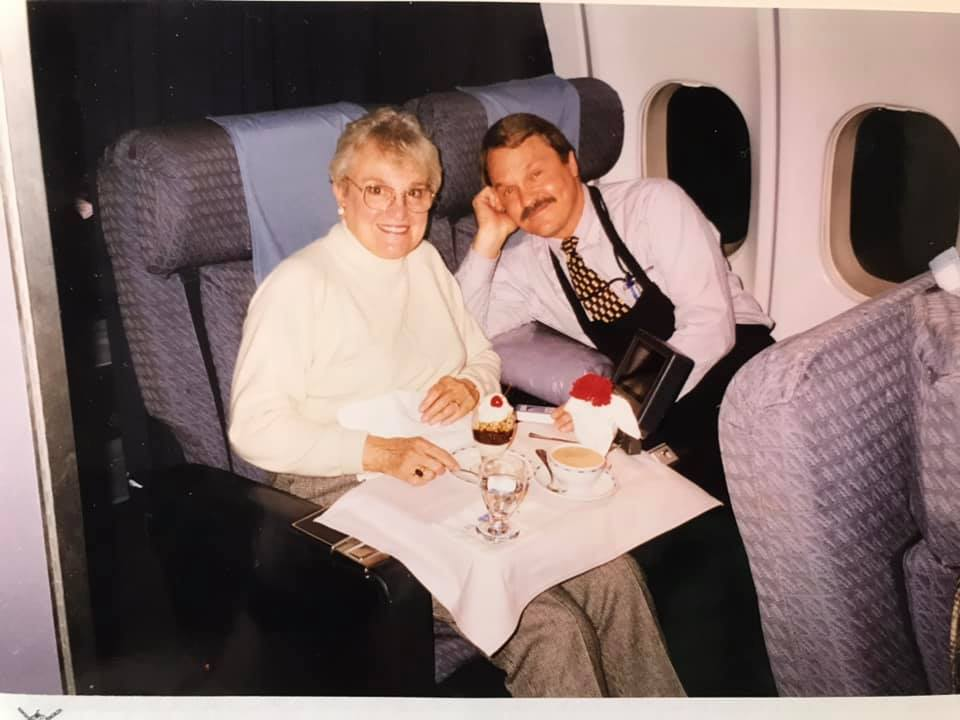
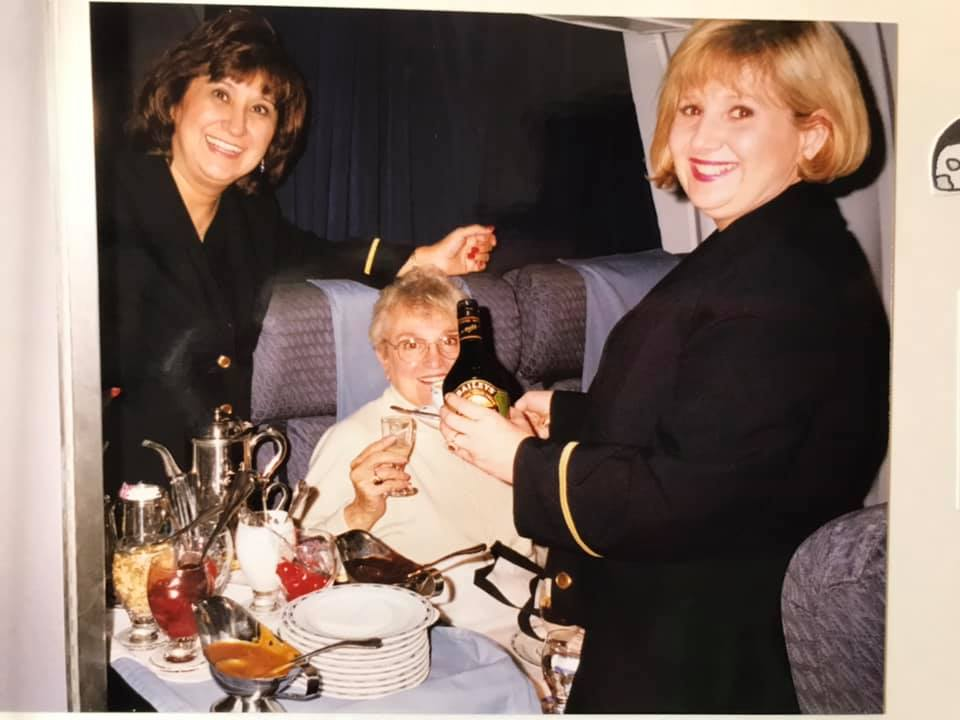
Now I have always been proud of Continental Airlines’ overall service, and especially our Business First, but the word got passed from the Gate Agent to the crew that my mother was coming aboard. I knew each and every member of that crew for several years, and knew that they would treat my Mom well, but from the moment she stepped onto the plane, my mother became EVERYONE’s mother. 

The QUEEN OF ENGLAND only wishes she could be treated as lovingly and as kindly as Mom was at the hands of my coworker friends. 

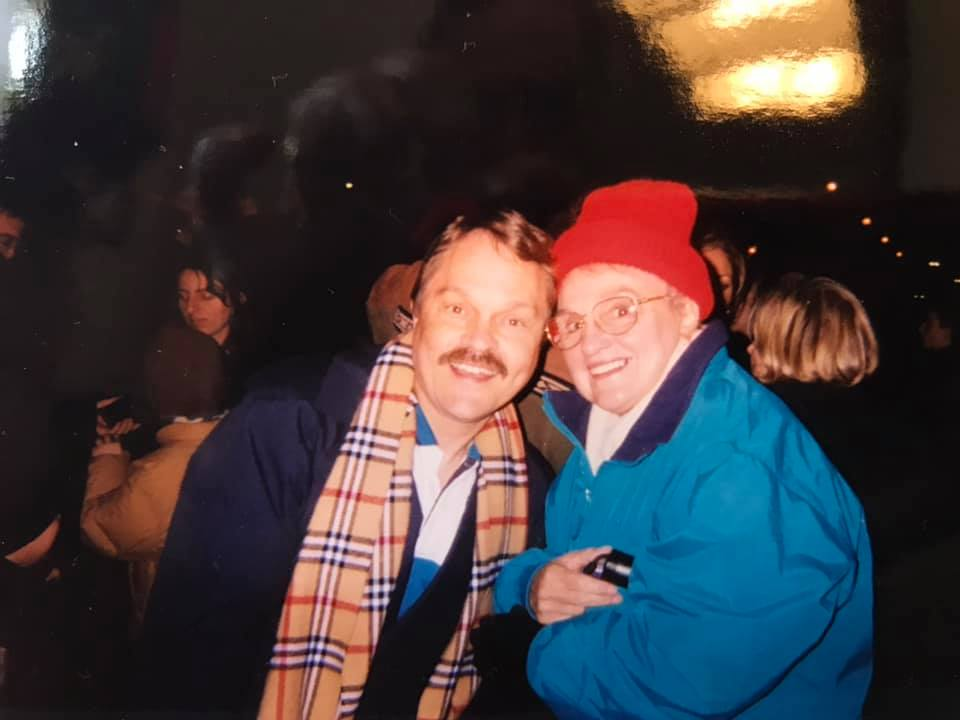
We enjoyed those two days in Paris immensely. It suddenly occurred to me that, in all my travels, I had never once invited my Mom to come along with me - even if it was a short trip. But this time I made up for all that as we stood among an international throng of revelers and watched the fireworks light up the Eiffel Tower from right across the Seine River. 

On the way back, it turned out that the flight was full. I had expected that and just hoped Mom would at least get on somewhere in Economy Class. We waited in line for our turn at the ticket counter. Employee pass riders are always taken care of last, as it should be, giving the best seats and preference to those who pay our bills.

Suddenly I got a tap on my shoulder. It was our Captain. 

”Hey, Kenny,” he asked, “What are you doing in the Economy Class line?” 

“Oh, we’re full,” I told him, “So there’s no way at all that she’ll get up to First Class.”

That’s when the Captain got upset: “Oh, NO! That’s just NOT ACCEPTABLE!” and he stormed up to the front of the line. 

Peggy, a very nice French gate agent I have seen many, many times before on my decade of coming to Paris, was swamped. Lots of folks to get checked in and accommodated, and very little time to do it. She was the one, in fact, who told me earlier that she could not get me First Class. She would have, if she could; this I know.

The Captain, visibly upset, went straight up to Peggy and said: “Why is Ken’s mother not in First Class??!”

“Well, Monsieur,” she answered quietly, “It is that we have so many passengers, so it is not possible…”

The Captain cut her off in mid-sentence and looked her right in the eye and commanded: “I am the CAPTAIN; FIX IT!” 

Peggy was startled, but she went right to her screen without a further word. In less time than that confrontation with the Captain took place, I received a tap on the shoulder. It was Peggy, holding a First Class Boarding Ticket in her hand. She smiled at me and told my mother “Bon Voyage.” 

Of course, my mother was treated once again to a warm hospitality that only friendship can bring, and the flight was yet another great part of a fantastic but all too short trip.


A week or so after the flight I got my photos developed, and I made a scrapbook for her, including tickets, receipts and other memorabilia. I went over for a visit to give her the binder full of memories, and she got teary-eyed. 

“You have no idea how much this trip has meant to me!” she said, and for a long time after that she still would mention the trip in conversation.


Then came the bad news that my mother had passed away. We were close, so the pain of loss was great. At the memorial service, her friends and fellow church members came up to me and said: “You know, Kenny, you just have no idea how much that trip meant to her. You know, she had this scrapbook and she brought it many times and showed us the pictures you took in Paris.”

Almost as painful as her loss was having to clean up and dispose of her belongings some time later. Among the items I found that touched my heart was the light green 3-ring binder that I used to make her scrapbook. I took it home where it and the cherished memories it contains will remain for as long as I live.


Thursday, May 2, 2019

Justin Wilson - 
𝓑𝓸𝓾𝓳𝓸𝓾𝓻! 𝓔𝓽 𝓒𝓸𝓶𝓶𝓮𝓷𝓽 Ç𝓪 𝓥𝓪??
                                                                                                            © KENNETH E. HALL APRIL 27, 2019 HOUSTON, TX


There once was an entertainer who became famous for his humorous faux-Cajun accent, his quirky humor, his broad smile and quick wit, his constant flow of malapropisms and, of course, his well-known Cajun cooking.
☺His name was Justin Wilson.
No, he was not Cajun; he wasn't even full-blooded Créole, by his own adnission, but he was born in Louisiana near the town of Amite - at least that. He was a well-known raconteur — a storyteller, a spinner of yarns who took delight in telling ordinary and sometimes very corny, over-told jokes with his made-up "Cajun" accent, throwing in lots of malapropisms into the gumbo. It wasn't the story itself that was funny... It was the storyteller.

To herd dis' man talk, you'd swear you had passed youself raaat down ta dem bayous of La Louisiane, I ga-ron-tee!

Justin Wilson cut many comedy records and had numerous appearances on TV and radio - including his own cooking show. I enjoyed his cornball sense of humor and listened to him every chance I got when I was a young adult. Like some wannabe amateur Elvis impersonator, I wound up by getting good at imitating Justin Wilson, sometimes even being asked to tell some Cajun jokes in his style at work when we had otherwise boring out-of-town sales meetings
Funny thing, though: I never heard a real Acadian speak that way, and in my life I have travelled extensively throughout Acadiana - even living a couple of years in Lafayette.
BUT.... my Great Uncle Léon Yuratich from way down in Buras spoke just like him!! He used to come over to my grandparents' and tell the funniest shaggy-dog storier I ever heard.

If one were to have visited the little orange grove River town of Buras, La. in around 1900, French would have been by far the dominant language, followed by Croatian. English came in at a distant third place, Chère! Haw 'bout DAT!?
My grandmother, also a native French-speaker from Buras, would do a double-take when I'd do my Justin Wilson imitation around her, and she would give me a sideways glance of doubious appreciation.....
The truth is, she did not like it, because she remembered moving up to New Orleans as a young lady in the 1920's, and being terribly ridiculed for her thick French accent by the locals. In those days, speaking English with a French accent meant to many that the person was from the country, hence ignorant and backward. Sad but true.

Imagine someone coming into a big-city place of business looking for a job and speaking like Justin Wilson!
My grandmother spoke true French, not Acadian (Cajun) French as her only language until she learned to speak English in school. So cruelly was she mocked that she eventually learned to speak proper "American" English, and thus landed a job as a telephone operator at the United Fruit Company in New Orleans. One had to have perfect diction to become an operator. Though she never said it, my MonMon wound up by speaking better English than many of the New Orleanians who laughed at her as a young girl.

Entertainer Pinky Vidacovich, another native of Buras, also did a Cajun shtick, but, like my Uncle Léon, he spoke that way in real life, too! He became famous with WWL radio's "Dawnbusters" program long ago, some time in the 1940's, and went by the stage name "Cajun Pete" — but, like Justin Wilson, there wasn't anything "Cajun" about him, either! Mais NON!
Decades ago, some people actually took offense at this style of humor, much in the same way some blacks decried the TV series "Amos n' Andy," accusing it of ridiculing the way blacks spoke. and my grandmother would have agreed.

I think most people who are themselves true Acadians, however, took Justin Wilson's tall tales and "Franglish" speech with the good-hearted spirit in which it was done.
Happily, his popularity was never diminished by any of his detractors.
Justin Wilson, by the way, was not the only Cajun humorist, nor was he even the first. Numerous others have done Cajun Humor like Dave Petijean and Marion Marcotte, the latter actually doing his stories in Cajun French!
I met Justin Wilson in person once up in "Yankee country"... way, WAY up north ... in West Monroe, Louisiana... at a hardware show. By then I knew most of his material and mannerisms by heart, but that didn't stop me from laughing at those jokes and enjoying the once-in-a-lifetime privilege of hearing him live. I went up to him after the program and got in character: "I'm mos' please to meet choo!" I told him.
"Well, I'm mos' please to meet choo, too!" He said with a firm handshake and a mile-wide grin. 

"Ya know, " I told him, "Me, I'm sure glad you brought youself way up yere! We're da only folk in dis place what don't talk wit an ACCENT!"

"I GAR-ON-TEE!!!" he said loudly.

Many people have said that what Justin Wilson did was "just an act."
Just an act? What difference does that make? Justin Wilson was an entertainer after all - an illusionist, of sorts, as ALL actors are. One could say the same about Clayton Moore, who played The Lone Ranger. He portrayed that self-appointed lawman for so long and was him so much that he eventually BECAME the Lone Ranger even off-screen, and was almost never seen out of character or without his trade-mark mask.
This begs the question: Was Clayton Moore the "Lone Ranger"?.... or was the "Lone Ranger" actually Clayton Moore?
The same, I believe, can be said for Justin Wilson. He created a persona which he eventually became, but since that persona came originally from him, it's difficult to separate the person from the persona.
MY question is: do we really need to pay attention to the man behind the curtain, when the illusion is so good?

This jovial lover of good cooking finally passed away at the ripe old age of 99½!!
Justin, ma frien', wherever you are, in Heaven or Perculatory, I hope you pass youself a good time, yeah!"


*Photo of Justin Wilson courtesy of Wikipedia:
By Source (WP:NFCC#4), Fair use, https://en.wikipedia.org/w/index.php?curid=45201592


When Dawn Turned to Daylight at 3 A.M.

                                                                                        KENNETH E. HALL      HOUSTON, TX        MAY 2, 2019


3:37 A.M.

I awoke suddenly in the middle of the night, but I had no idea why. There was nothing to explain my waking jump, but something was amiss, that was for sure. I sat up in bed in the pitch-dark blackness of the bedroom, listening - - -  but there was only silence.

Our windows were these crummy aluminum things that wear out quickly and rattle whenever so much as a pickup truck goes by on the street. Every single house that was built in the 1970's had them, and they were great when installed, but after only a decade or so, they were no longer the same as when they were new. For example, the window by the dining room table in my house had a broken latch, and I had cleverly wedged a bamboo chopstick in tightly by the lock so it could not be opened unless we wanted it opened. That was my idea of keeping my home safe - a chopstick wedged into a window lock!

Ours was a quiet suburban neighborhood after sundown, and tonight was no exception. But then the predawn silence was broken by the sound of that chopstick falling to the dining room floor. My eyes opened wide in the pitch black darkness. The hair stood up on the back of my neck! 

SOMEONE WAS TRYING TO GET IN!!!

Next to my bed, leaning against a corner wall, was my buddy, "Mitch" -  a large, real machete (cane knife) I had bought as a souvenir in Guatemala nearly 2 decades ago. I sprang out of bed, grabbed the large knife and drew it from its ornate leather sheath. Then I sneaked into the hallway and headed toward dining room, ready to do battle with whomever was trying to gain entry into our house through that living room window.
My heart pounded in terror, my face flushed red; I had never confronted an intruder mano-a-mano before and even though I was well-armed with my machete, thoughts now hit me: what if the other guy is ARMED - as in with a GUN??!! What if there were two or more people looking to break in?? What if....??

These and a few other scary thoughts raced through my mind as I neared the place where the hall opened up into the kitchen / dining room area. I made no noise at all as I crept closer and closer, ducking down to keep a low profile. The blue-white light from the streetlamp outside filtered in through the window and since I was coming from the dark, I found I could see well enough to find a burglar, even in the shadows. Of that I was certain. I stood there with my eyes scanning every dimly-lit cranny of the dining room fully expecting there to be someone, weapon in hand, crouching, waiting, lurking in the shadows.  

After looking around thoroughly I entered the living room / dining room area. I saw no one, much to my relief, but I then figured whoever it was was probably still outside, still trying to jimmy the window open. 

I had to have a strategy. Not to have one would have me go off "half-cocked" as my grandfather used to say. Going out the front door would expose me, I thought, and I would be vulnerable to attack, so I decided I could use the door on the left-hand side of the garage and exit to the front of the house through the alley and take the culprit by surprise. Quietly, or as quietly as the lock mechanism would allow for, I made my exit through the side door. Cautiously I looked all around me before proceeding, lest the intruder or intruders take ME by surprise. It was then, while I was in the side yard, that I noticed the sky was a bright yellow-orange. I scratched my head, wondering why the heck it was so bright - it couldn't be dawn yet, could it?  But never mind; I had my house and family to protect.

Just as I came around the side of the house and approached the front, fully expecting to see whoever it was, I heard a car start up two doors down from our place, and tires squealed loudly! The car raced down the block and around the curve at the end of the street and was gone in an instant. Wow! My heart was pounding with excitement. 

I did well, I thought to myself! I had surprised whoever it was, and he or they beat a hasty retreat. Much relieved that the immediate threat was apparently gone, I went inside, more than a little rattled but happy and relieved the incident was behind me.

But that SKY! It was dawn already....

I went back to bed, and despite my adrenaline rush and near-encounter with some nefarious person, I fell asleep soon thereafter. 

THE SMOKE

I suddenly awoke with the alarm clock, got dressed and ate a bite, then drove to work. I lived in a modest brick house in LaPlace, LA - a former sugar cane town turned bedroom community for New Orleans and nearby petrochemical plants. All up and down the nearby Mississippi River was an unbroken stream of oil refineries and chemical manufacturing plants - so many that the River Parishes area was nicknamed "Cancer Alley" - and it was so-named for good reason.  Today, it was not cancer that was on everyone's mind.

I headed for work, getting on Interstate 10 E as usual, and put the local radio on to relieve the boredom of the long commute ahead of me. I was on the overwater section of this highway when I sighted a very thick, dark plume of black smoke belching from one of the plants. It was at this very moment that I learned from live radio that there had been a huge explosion at the Shell Oil refinery at NORCO, LA - just a twenty minute drive from my house! According to the radio, it happened at 3:37am this very morning - - - THAT was why I awoke suddenly

As I came to a break in the trees, I could now see more clearly the distant towers of the NORCO petrochemical complex, and the thick, black plume of smoke that rose from it. The familiar tall flair tower whose beacon shown for miles was obscured amid all the smoke and soot in the air.

Like residents of a mining town who heard the whistle indicating a disaster had befallen those in the mines, today, those who lived and worked in the industrial towns along the river that day awaited news - who would come home, who lay badly hurt, and who would not be coming home at all. Through the day and into that evening, grim reports filtered in about the injured and the dead. This was indeed a tragedy. Everybody knew somebody who was killed, injured or grieving. I was no exception.

I returned to my house that afternoon to find my daughter in tears. Not one, but several of her school friends had either found out that their fathers had died, were injured, or were among the missing. As for the car pealing out down the street early that morning, it was a neighbor who worked for Shell heading down to the disaster site to help out during the emergency. The falling chopstick that I took for a burglar attempting to gain entrance to my house was no doubt dislodged from the force of the explosion, a noise which I did not consciously hear but was awaken by.

The main part of the refinery fire was extinguished soon, but thick, black smoke billowed high into the air and was visible for miles. It was a stark, somber reminder of those who lay maimed in a hospital bed and for those who did not make it.

At that time, I was a salesman for a tool manufacturer, and there was a competitor of mine whom I met occasionally at trade shows. His name was Ernie Carrillo. At trade shows and conventions we would chat, and got to know him as Ernie instead of as a competitor. We all had our jobs to do and we all had families to feed.

I later learned that Ernie quit the job he had when I knew him to work in a better-paying position at Shell, so he could more adequately provide for his family. It seems that, on the evening before the explosion he had switched shifts with a fellow worker to help out a friend who needed the night off, because Ernie was always there when someone needed him. He wasn't even supposed to be working that night. Ernie Carrillo was high up in the catalytic-cracking tower of the Norco Refinery when it blew up. His body was found on May 6th.

AFTERMATH

The smoke eventually cleared, the ruins were sifted for clues about the cause of the explosion. The destroyed parts of the plant were rebuilt - hopefully to better safety standards, all the legalities were dealt with and all the checks were written. The dead were mourned, honored and buried. the injured recovered as best as they could. Life went on. 
Much has subsequently been written about the who, the why, the how, and the aftermath of this tragedy. 
But the loss of a husband or a father or a brother cannot be paid for by a settlement check or improved procedures. Those losses are written in stone.

Three decades later, the lofty flair tower that has for long been a NORCO landmark can still be seen for many miles in the distance, and it burns bright, like an eternal flame, and many say it burns to the memory of those who died there, and those who went on living with the pain and the memory of that sad day, the day when dawn turned to daylight at 3 a.m. 


 “On May 5, 1988, an explosion occurred at the Cat Cracking Unit which forever changed the lives of Shell Norco employees and the Norco community. This memorial isdedicated to the seven employees who lost their lives.”The seven are then named: Ernie Carrillo, Bill Coles, Lloyd Gregoire, John Moisant, Jimmy Poche, Joey Poirrier and Roland Satterlee.


Published on
5/2/19 12:16 PM
Edited (1) Feb 3. 2024 8:38PM


Monument dedicated at Shell to men who died Published 12:00 am Wednesday, May 6, 1998  By Staff Reports  By Leonard Gray / L’Observateur / May 6, 1998

Read more at: https://www.lobservateur.com/1998/05/06/monument-dedicated-at-shell-to-men-who-died/
  “On May 5, 1988, an explosion occurred at the Cat Cracking Unit which forever changed the lives of Shell Norco employees and the Norco community. This memorial isdedicated to the seven employees who lost their lives.” The seven are then named: Ernie Carrillo, Bill Coles, Lloyd Gregoire, John Moisant, Jimmy Poche, Joey Poirrier and Roland Satterlee.


Read more at: https://www.lobservateur.com/1998/05/06/monument-dedicated-at-shell-to-men-who-died/


SOURCES 


https://www.lobservateur.com/1998/05/06/monument-dedicated-at-shell-to-men-who-died/

"The Norco Louisiana Shell Explosion of 1988"

A first-person article by Darin Acosta can be found here:

http://darinacosta.com/2016/05/05/norco-shell-explosion-1988


WashingtonPost Newspaper article - May 6, 1988:
https://www.washingtonpost.com/archive/politics/1988/05/06/1-dead-6-missing-as-blast-at-shell-oil-refinery-rocks-louisiana-town/a8ddcf3a-047d-4bd9-b23c-90d88a85639d/?noredirect=on&utm_term=.b5a353417168

Sunday, March 3, 2019

From Transportation to Liberation


From Transportation to Liberation ---
 - - - - - - - New Orleans' Southern Railways Terminal
                                                                                                 ©KENNETH E. HALL    HOUSTON, TX      MAY 1, 2019


𝓝𝓸𝓽𝓱𝓲𝓷𝓰 𝓲𝓼 𝓬𝓸𝓷𝓼𝓽𝓪𝓷𝓽 𝓫𝓾𝓽 𝓬𝓱𝓪𝓷𝓰𝓮!

Nowhere in the United States has the love for the past so permeated into the culture of a community as it has in New Orleans. It can be said that New Orleanians are obsessed so much with what WAS that they miss what COULD be. There are many who do not share that point of view.

To be sure, the history of the city since its founding by the French in 1718 has been one of nothing BUT change - catastrophes such as major conflagrations, wars, and windstorms like Katrina. Each disaster left an indelible mark on the psyche and on the physical landscape of the city.

New Orleans has for long been divided into two factions: progressivists and preservationists. The preservationist extremists tend to oppose any project or change anywhere in the city, for any reason - in the name of potential "historical significance" (real or perceived). The converse is also true: Progressive extremists would bulldoze the entire French Quarter and pave over the area to make parking lots, if those once they had their way. Fortunately, most of the time at least, common sense and compromise has had its way, and after the dust settles, new projects are undertaken and architecturally valuable structures are usually spared demolition to make way for them.


♫♪♫♪♫♪♫

"Won't you come along with me
To the Mississippi
We'll take a boat to the land of dreams
Steam down the river, down to New Orleans...
The band's there to meet us
Old friends to greet us
Where all the light and the dark folks meet:
Heaven on earth - they call it Basin Street!" - - - 
                                        ♫ Basin Street Blues, as recorded by Louis Armstrong and his Hot Five in 1928

♫♪♫♪♫♪♫


𝓛𝓪 𝓡𝓾𝓮 𝓑𝓪𝓼𝓼𝓲𝓷 - Basin Street

ABOVE: AN EARLY VIEW OF BASIN STREET, STORYVILLE, AND THE REAR OF THE SOUTHERN RAILWAY DEPOT. THOSE BOOKING PASSAGE ON THE REAR CARS COULD SIMPLY DISEMBARK AND BE IN FRONT OF A FAVORITE BROTHEL IN A MATTER OF MINUTES. FOR THIS REASON, THE TERMINAL HAS BEEN CALLED THE "FRONT PORCH OF STORYVILLE". 

In the grand old river city of New Orleans, there is a street made famous by a song, "Basin Street Blues." Basin Street is a divided thoroughfare running perpendicular to Canal Street - New Orleans' main avenue. It is just one street over from the original city limits - Rampart Street. In other words, it runs just outside of the French Quarter and continues a few blocks past the French Quarter, then curves into and becomes Orleans Avenue. That's the way it is today, but go back 100 years, and things were much different.

Basin Street, infamous for its Storeyville Red Light District of long ago, and immortalized by the Jazz music that was born there, got its name from a turning basin for ships travelling on the Carondelet Canal. The canal itself was constructed on orders of the Spanish Governor of Louisiana from 1791 to 1797, Don Francisco Luis Hector de Carondelet, 5th Baron of Carondelet, and was subsequently named for him. After well over a century of heavy use, the Carondelet Canal was eventually closed and filled in during the 1930's.

In the late 1800's and into the early 1900's, while the canal was in use, railroad tracks ran alongside, terminating at one of New Orleans' main railroad depots on Canal Street. The end of the line was the beautiful Southern Railway Terminal. The Crescent City was indeed a major hub of water and rail transportation, and remained so for decades to come, and the hub of all this activity was Basin Street.


A view of the newly-completed Southern Railway Terminal.


CANAL STREET - 1950
The Southern Railway Terminal at 1125 Canal Street is PARTIALLY visible behind Canal streetcar #801. The movie "Fancy Pants" with Bob Hope & Lucille Ball was playing at the Saenger Theater on the day this shot was taken. That movie was released July 19,1950, and Saenger used to get the movies shortly after release dates, so my guess is somewhere around 1 August, 1950. The terminal had less than five more years of existence, and the Canal Streetcar line itself was 14 years away from becoming a memory. 


Originally called the "New Orleans Terminal", it was constructed in 1908 by the Southern Railway on the median of Basin Street where it intersects with Canal Street. [I would like to note here that the building was designed by the architect for the much larger Union Station in Washington D.C., Daniel Burnham. As a resident of D. C. for several years as a child, Union Station was among my favorite buildings.] The station also served the New Orleans & Northeastern (NO&NE) and the New Orleans Terminal Company. 

From this imposing alabaster building in the very heart of the city, people could travel to such places as Washington D.C., Louisville, Memphis, Cincinnati, St. Louis, Savanna, Charleston, and Jacksonville. They could make day excursions to nearby Gulfport, Mississippi as well. Additionally, the terminal brought another type of clientele. For the first decade of its existence, in the words of NOLA.com: "it was in a way the front porch of Storyville, the place where trains would deposit them for a night of debauchery in the district. According to reports, some particularly welcoming Storyville prostitutes were known to strip down nude and beckon to passengers from their windows as the train passed on Basin Street." Storyville was located just one block away from the terminal.

In the days before Jim Crow, Basin street truly was the place, as the ORIGINAL version of Basin Street Blues says: "Where all the light and the dark folks meet". And so they did - - - in more ways than one. As the U.S. got involved in World War I and New Orleans became an important military city, Storeyville's "dens of iniquity" were closed by order of the Navy - for obvious reasons. The Navy did what the church and city government could not - or would not do. Storeyville operated from 1897 to 1917 - a short twenty years - yet its memory lives on in the music and folklore of New Orleans.


Les Chemins de Fer - The Railroads

New Orleans prides itself on its French heritage, and the city always desperately wanted itself to be likened to Paris. One comparison that can be made is its railway organization - - - or more specifically the LACK of organization. 

Paris at one time possessed many railway stations, and they form a ring of dots around the city. Everything ends in Paris, it was once said, and Paris made sure this was the case. Trains from Lyon ended at the Gare (train station) de Lyon. Trains coming from Luxembourg terminated at the Gare de Luxembourg, and so forth. This arrangement was logical - Gallically speaking - and benefited both persons travelling to and from Paris, as well as the places served by the railways. But what if one was going from Lyon to Luxembourg? A change of trains was necessary, and that was an ordeal to say the least, requiring the hiring of a coach or taxi and a lengthy Odyssey through the narrow, congested streets of Paris. Not very practical. 

Like Paris, trains tended to terminate in New Orleans, and they did so at one of several stations. Again, like Paris, it was a hassle getting from one terminal to the other. Like Paris, the city of New Orleans delighted in its terminus status and its beautiful railway stations, and people travelling by train from Miami to Los Angeles would have to go through the same cumbersome procedure as did the poor travellers in Paris. 

Like Paris, there was much grumbling, but little or nothing was actually done about this multi-terminus situation until it was too late. Paris still has several railway stations (albeit fewer in number) but there are intracity trains and Métro lines that make the change of trains a bit less of a headache. 
Unlike Paris and the whole of Europe, for that matter, passenger trains in the U.S. were, just after WWII, beginning a decline - a decline that would eventually see the virtual demise of intercity passenger rail travel - and certainly the decided marginalization of that form of transportation almost to the point of irrelevancy within just two decades.

Never mind the writing on the wall, businessmen and politicians alike thought this consolidation of passenger rail would benefit the public in general. It was a great idea - but, sadly, one whose time had come and gone. 


"The steel rails still ain't heard the news..."


UNION PASSENGER TERMINAL - 1001 LOYOLA - AS IT APPEARED IN 1957 WHEN I TOOK A TRIP TO WASHINGTON, D.C. WITH MY GRANDMOTHER. I PURCHASED A FULL BOX OF 1,000 OF THESE POST CARDS FOR $1.00 FROM THE GIFT STORE OF UPT WHEN THEY WERE LIQUIDATING SOME OF THEIR INVENTORY. HAPPILY, TODAY, A NEW STREETCAR LINE SERVES SERVES THIS PASSENGER RAILROAD TERMINAL! SADLY, THERE ARE VERY FEW TRAINS USING THE FACILITY.

On January 8, 1954, the Union Passenger Terminal (UPT) opened its doors, and the place instantly became the city's rail hub. My grandfather commented at the time: "Railroad depot? The best thing can be said about it is that it would make a great place to raise mushrooms!" He was by no means a cynic - I like to think of him as an "enlightened realist". He would soon be proved correct, as the "writing on the wall" became the procession of notifications of cancellations of trains and cutback on service. Modern intercity buses, and the almighty automobile - both forms of travel that were largely responsible for killing off the streetcars in the United States, were eating into the ridership and profits of the once-great and powerful railroads, and they now were aided in their effort by the mighty and burgeoning Interstate Highway system that was set in place by President Dwight D. Eisenhower.

There was one other elephant in the room - After WWII, Americans sought to travel more than ever before, and airlines offered an excellent and faster alternative to the train. People born at or before the Turn-of-the-Century were somewhat reluctant to embrace the idea of air travel, at least at first, but those of my mother's generation were quick to take to the air, and they did so in droves. The trains could not, and would not compete. So, as in the words of the Arlo Guthrie song "City of New Orleans": "This train's got the disappearing railroad blues!"

Getting back to the Southern Railway Terminal, although beautiful, the city could not abide such a beautiful structure. That attitude towards architecture permeated the city for awhile, and structures far more beautiful and historical fell to the wrecking ball and the jackhammer. So it was with this one. Rails were ripped up, streets were redesigned, and the monument to American engineering and economic power was reduced to rubble in short order. 


ABOVE: NOLA.com's interesting article entitled "The Last Gasp of Storyville, in a Single New Orleans Photo" shows the station in its last phases of demolition.


No hay mal que por bien no venga. -- Spanish proverb, roughly equivalent to "Every cloud has a silver lining."

As the grass was growing green where once steel wheels did glide along on steel rails, it was now decided to erect a monument to, of all people, a Venezuelan politician! During the 1950's, the city of New Orleans still enjoyed a thriving trade with Latin America, and cultural and historical ties to the many nations to the south were strong. There were quite a number of residents of the city from all over Latin America, and there were also many New Orleanians living down there - so many so that only four years later, VIASA Airlines even began flying direct flights to Caracas from the city's expanding Moisant International Airport (MSY). 

Eager to further "Latinize" an already historically Latin city, the mayor willingly accepted a gift from Venezuela and Venezuelan businessmen, of a statue and mini-plaza dedicated to a hero and liberator to not just Venezuela, but to six countries in South America. It can be said that Simón Bolívar was the George Washington of Latin America, and the erection of the statue paid homage to that fact.  

On November 25, 1957, a 12' tall, 7 ton statue of El Libertador - "The Liberator" - Simón Bolívar - was dedicated with much fanfare, and by this naturally I mean a PARADE! This was, of course, New Orleans, and that is how we do things... with a great deal of whoop-la! On hand at the ceremonies was Mayor deLesseps "Chep" Morrison, who touted the monument as yet another example of the Crescent City's warm relationship with Latin America. The flags of the six countries liberated by Bolívar were raised, and we enjoyed a time of warm friendship and mutual respect... at least for awhile. The monument to Simón Bolívar was placed in the very same spot where the Southern Railway Terminal once stood. Within a few years, monuments to Mexican and Honduran heroes were also erected. Now, in addition to street names such as Madrid, Salcedo, Ulloa, Rendon, López and others, monuments to people revered by Latin Americans are featured prominently on one of the city's major boulevards. 

This site has gone from transportation to Liberation!


                                            REMNANT

In the late Sixties I worked at Jaeger's Seafood Restaurant, at 1715 Elysian Fields. One day, for whatever reason, I decided to take a walk on the neutral ground (median) of that grand boulevard. In about the 1800 block I saw what at first looked like an old, forgotten tombstone! New Orleans is famous for things that seemingly do not belong, yet nonetheless are there anyway. I wondered what timely person lay sleeping beneath a granite stone in the median of a great thoroughfare! Upon closer examination I discovered it not to be a tombstone, but rather a mile-marker, bearing the inscription: "ONE MILE FROM RIVER". At that time (I was a teenager) I had no idea that there had ever been any rails on Elysian Fields. I learned as I got older that this was a major railroad artery with several sets of tracks and plenty of trains. To my knowledge, this stone is the only remnant to a once-thriving rail operation that has come and gone. 

Sadly, I was too young to have any memories of the old Southern Railway Terminal on Canal Street. So many other things have changed that the city I grew up in is today almost unrecognizable in some parts. In my view, far too many wonderful things I recall about my youth and childhood have disappeared - gone to join the swelling ranks of things  that I look back upon. 

A poem entitled DESERATA advises me to "Take kindly the counsel of the years,
gracefully surrendering the things of youth..." - but I am not so sure how graceful I have been so far - or will be in the future as more and more things fall by the wayside.
On the other hand, the streetcars, once ripped up literally overnight from Canal Street, and consigned to the scrap yards and museums, have happily returned, and one new line serves the Union Passenger Terminal.. 


   ⚜      

For historical views of the Southern Railways depot and other stations, check out "Old New Orleans.com" at:
http://old-new-orleans.com/NO_Stations.html


For a photo and info in the Simón Bolívar monument, check out Blake's page:
https://www.theadvocate.com/gambit/new_orleans/news/blake_pontchartrain/article_9f0bd142-e2d2-53bb-855d-f0c31a6785e5.html

and this is also an interesting article on the statue:
https://www.nola.com/entertainment/2019/03/mardi-gras-parade-cam-watch-the-krewes-of-hermes-detat-and-morpheus-roll-live.html

and finally, a link to a photo of the demolition of the Southern Railway Terminal:
https://www.nola.com/entertainment/2019/02/the-last-gasp-of-storyville-in-a-single-new-orleans-photo.html

DESITERATA  - Max Ehrmann, Desiderata, Copyright ©1952.

Sunday, January 6, 2019

The Hole in the Book

The Hole in the Book

                                               ©KENNETH E. HALL       JANUARY 6, 2019         HOUSTON  

In December of 1984 I met a most interesting elderly couple - a Mr. and Mrs. Roy Segall. Our meeting at a party led to an invitation to visit them at their home, an invite which I most willingly accepted. At their home, our conversation was stimulating enough - we spoke of various things, and spoke in English, German, French, and Russian. Roy was conversant in several languages, as was typical among Jewish immigrants. When I asked about his origin, that is when it got even more interesting.

Roy explained that the name "Segall" was made up of two parts: the first being Segan and the second being Levi. Back in the annals of Judaism, a Sagan was described as one who replaced a high priest (Levi) if he were unable to fulfill his duties, hence, Sagan-Levi.

In looking around his study, I noticed he had a respectable collection of books. In the center of his large bookcase was a set of perhaps two dozen larger books in an exquisite blue binding. No, this was not an encyclopedia, for none ever existed with such a high quality of craftsmanship. As I drew closer to have a better look, my eyes were drawn to a hole in the spine of one of the volumes toward the center of the set. It had a peculiar shape - about an inch in length and was elliptical  - a sort of vertical puncture slit in the middle of the binding's spine.

As one who appreciates a well-bound book, I was sad that some bad luck had aparently befallen the collection, for one of the tomes to be thus marred and damaged. This sentiment I expressed to Roy, and he grew serious and bade me sit down so he could tell me the story  - of the hole in the book.

                      卐     卐     卐     卐
☭It was in the early Forties. Lithuania, at that time a "Republic" of the Communist USSR (since 1919) , had been invaded by Nazi Germany. To most people, Nazi occupation was naturally greatly feared and strongly resisted. This was not necessarily so in Lithuania! When the German troops goose-stepped into that tiny Soviet Republic in 1941, instead of trembling in fear, many Lithuanians saw Nazi occupation as a liberation of sorts. Here, many thought, was their chance to throw off the Soviet yoke - to finally rid themselves of Russian repression and push later for greater autonomy eithin the Third Reich.

There were others who did not see this invasion as a good thing. Among those who were terrified of the onslaught were the approximately 208,000-210,000 Jews living there - and for good reason. They had heard of massacres and persecution of Jews elsewhere, and were not sticking around to join the welcome party for the Nazi invaders.

Early on, Jews were simply expelled from some areas, but as The Final Solution made it clear that Jews were to be exterminated, Einsatzgruppen (German death squads) pursued or hunted these refugees relentlessly, massacring them in large numbers. These Einsatzgruppen set up checkpoints to intercept refugees and kill them on the spot. Most Jews decided to run for their lives rather than stay and be shot where they lived - but fleeing was also extremely dangerous.

As has happened in other countries, many Lithuanian Jews were aided in their escape by fellow locals (and as a result, numerous non-Jewish Lithuanians were summarily shot for helping them!)

Roy described in vivid detail the day his family boarded a hay wagon. They were told to keep absolutely quiet. It was not too far from the border, and from there they could find help as best they could. The next few kilometers, however, would represent life - or death.

The wagon, pulled by an old horse and piled high with hay, was a common sight in the picturesque countryside, and consequently drew no attention at all - that is, until the checkpoint was reached. The wagon was driven by a farmer, a kindly local who had previously helped others through this gauntlet. He was, once again, knowingly risking his life for this innocent family.

The horse plodded on for what seemed like an eternity. This was by no means a First-Class rail ticket! Hay needles stuck and itched, and the load sometimes shifted a bit, filling the air with otherwise fragrant hay dust, but none of the huddled children in that old trap dared to complain or even sneeze. They sat perfectly still as the cart slowly rocked along that bumpy dirt road.

Up ahead, the farmer could see about a half-dozen German troops milling about and a gate arm that represented to the family he was carrying not only freedom but also LIFE itself!! The farmer gave a slight whistle, meaning to communicate to his passengers that they were nearing the border, and everyone hunched down - now trembling with fear.

These particular border guards were not Death Squad members - they were just a few ordinary low-ranking soldiers who only wanted to get through the day. They had seen the farmer several times before, delivering his "hay" and thought nothing of it - but they had to do their duty.

"HALT!" shouted one guard - the wagon came to a standtill. Two others gave a cursory look around - and even UNDER it. Then one of the guards, just to be sure, thrust his rifle with fixed bayonet deep into the huge mound of amber hay! It was stopped - probably by the wooden side of the wagon. It was a cursory probe - these guards really did not want to be bothered.

"RAUS!" shouted the same guard - get out of here! The farmer shook the reigns, and the old horse plodded on down the dusty road. To the farmer and that old mare, it was just another delivery of hay to a nearby stable. To little Roy and his siblings, their lives had been spared.

"And you see this," Roy said, his voice wavering as he picked up the volume and pointed to the hole in the book, "THIS is where the German bayonet hit... We had piled up these books around us in case this were to happen, and it did... and I was right behind this very book. So you see," he continued, "This is my FAVORITE of all the books I have ever owned, for it saved my life - and my family's!"

Never judge a book by its cover!
✡
There are milllions of stories - many did not have such a pleasant outcome. Many did not get to be told. This man was one of a small number of survivors who lived to tell the tale. I do not want his story to die with him. I want to share Roy Segal's story especially with anyone who believes the Holocaust did not happen.

Wikipedia says:
"Out of approximately 208,000-210,000 Jews, an estimated 190,000–195,000 were murdered before the end of World War II (wider estimates are sometimes published), most between June and December 1941. More than 95% of Lithuania's Jewish population was massacred over the three-year German occupation — a more complete destruction than befell any other country affected by the Holocaust."